Introducing Signal: Client Reporting for Ecommerce Agencies
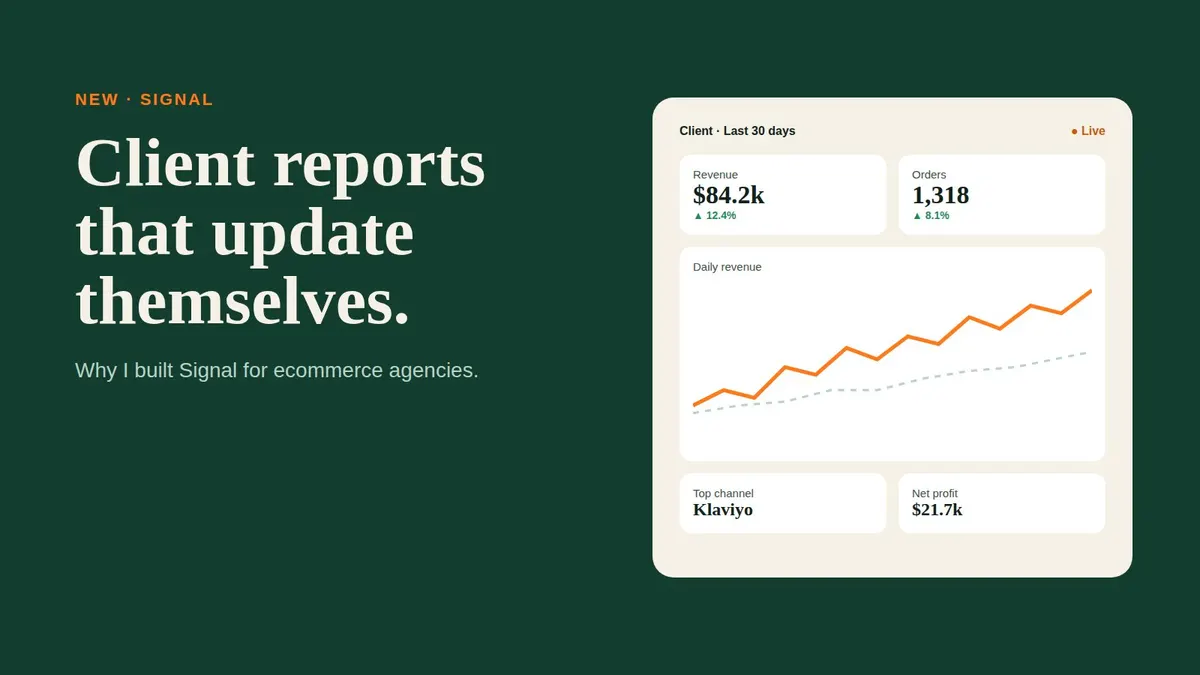
For the last few years I’ve led a development team that looks after a handful of direct-to-consumer brands: Tikva, Contours Rx, Howdy Snax and others. The code was never the part that ate our Mondays. The reporting was.
This month I launched Signal, a client-reporting dashboard built for exactly that problem. Here’s why it exists and how it works.
The Monday-morning problem
Every agency that runs Shopify stores knows this routine. A client wants to know how last week went, so someone on the team:
- exports orders from Shopify,
- screenshots Triple Whale for attribution,
- copies campaign revenue out of Klaviyo,
- pastes it all into a deck or a PDF,
- and emails it, knowing it’s stale by Tuesday.
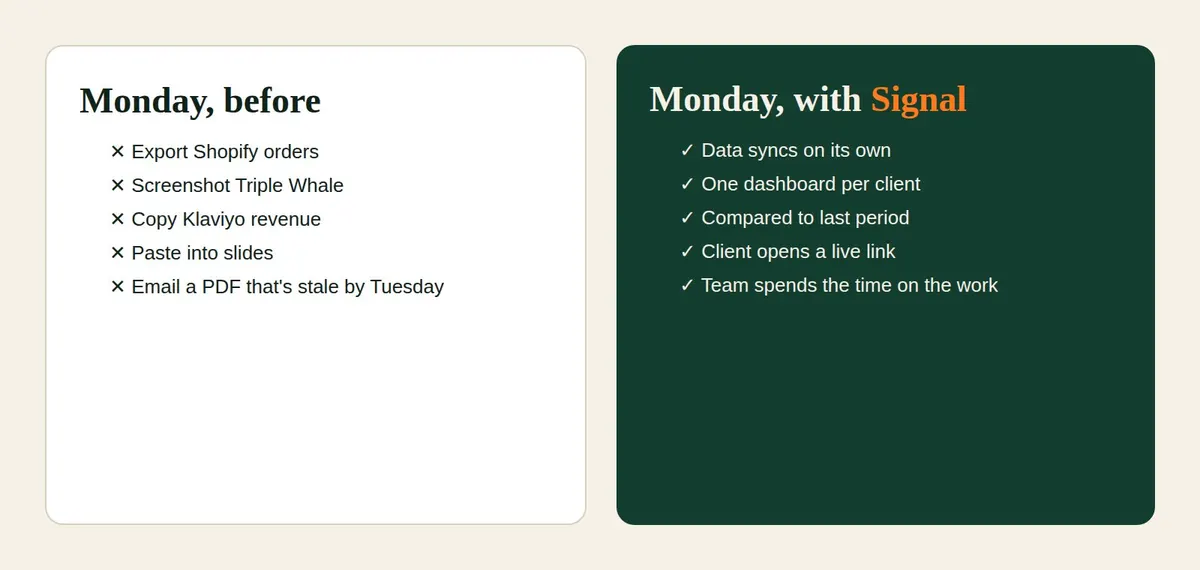
Multiply that by ten clients and you lose a day a week to copy-and-paste. Worse, the client still messages on Thursday asking, “How are we doing this week?”
I’d already built a version of the fix once. For Contours Rx we put together a weekly performance dashboard on Cloudflare Pages that combined Triple Whale and Klaviyo, and the reporting chore disappeared. Signal is that idea, turned into a product any agency can use.
What Signal does
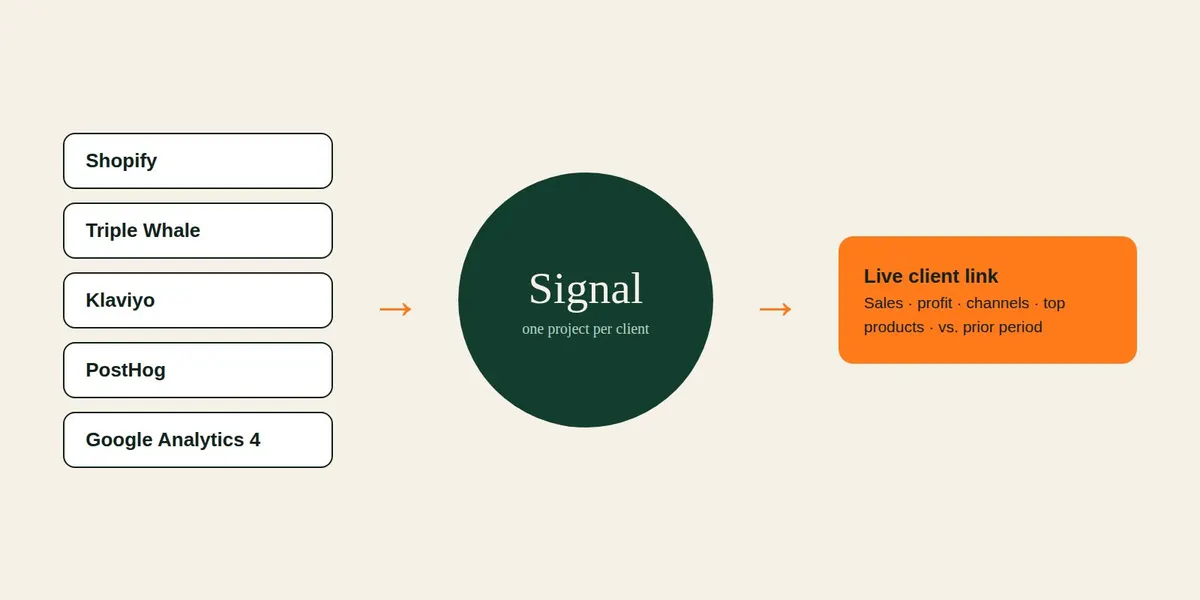
Signal connects to the tools ecommerce brands already use and turns them into one live dashboard per client.
- Shopify-native sales: orders, revenue, discounts and daily trends.
- Product-level profit and loss: net revenue, refunds and return rates per product, not just a top-line number.
- Channels and affiliates: which referrers and discount codes are actually driving sales.
- Prior-period comparison: every number sits next to last period’s, so trends are obvious at a glance.
- Five integrations: Shopify, Triple Whale, Klaviyo, PostHog and Google Analytics 4, connected per project, so each client only shows what they use.
Share a link, not a PDF
This is the part clients like most. Each project gets a permanent, read-only share link. The client opens it with no login and no new account to create, and sees live numbers every time. No more “can you resend the report?” emails, and no more reports that are out of date the moment they’re sent.
For the agency, every client lives as a separate project in one workspace, so switching between brands is one click instead of five browser tabs.
Built by someone who does the work
I didn’t design Signal from the outside. I’ve spent 14 years building WooCommerce and Shopify stores, and my team still maintains stores every day. The metrics in Signal are the ones clients actually ask us about, laid out the way we explain them on calls.
Under the hood it runs on the same stack I use for client work: Cloudflare for speed and reliability, with data kept in sync automatically, so the dashboard is always current.
Pricing
There’s a free plan for one project with all the core dashboards and no credit card, which is enough to try it on your biggest client. Paid plans scale by the number of projects (Starter, Growth and Scale), billed monthly through Stripe and cancel anytime. Current prices are on the pricing page.
Try it
If you run an ecommerce agency, or you’re a brand tired of chasing reports, create a free Signal account and connect one store. It takes a few minutes.
And if you’d rather I set it up for you, or you need custom reporting beyond what Signal covers, get in touch. Building dashboards and automations for stores is part of what I do.